2 September 2026
Establish a Branch in Denmark
Our specialists can help you establish a branch in Denmark and advise in regards to its advantages and disadvantages for foreign investors.

The branch is a separate office of the company, based in a different jurisdiction where the foreign corporation expands its business activities. It can carry out any of the activities the foreign company is allowed to perform, however, it cannot expand beyond these. In essence, the Danish branch is an extension of the parent company that has a set of advantages and is a preferred means of business expansion, especially for banks and other financial institutions. Foreign investors who want to start a company in Denmark through a branch office, can receive specialized assistance from our team.
| Quick Facts | |
|---|---|
| Applicable legislation (home country/foreign country) | The branch operating in Denmark is subject to Danish law. |
Best Used For | The same business activities as the parent company abroad |
| Minimum share capital (YES/NO) | NO |
| Time frame for the incorporation | 1 week |
| Management (Local/Foreign) | Locally managed by one or more appointed branch managers |
| Legal representative required (YES/NO) | YES |
| Local bank account (YES/NO) | YES |
| Independence from the parent company | NO |
| Liability of the parent company | Full |
| Corporate tax rate | 22% |
| Possibility of hiring local staff (YES/NO) | YES |
| Mandatory name requirements for the Danish branch | Must contain the foreign company's name, the word "filial" and an indication of the company's nationality |
Branch name restrictions | Cannot infringe any existing trademarks |
Branch Memorandum and Articles of Association | Required, provided by the foreign company |
| Mandatory document translations | Yes |
| Changes to the branch | Possible, however, any such change must be duly notified to the Danish Business Authority |
| Legal capacity | No, the branch cannot act in its own name, the foreign company acts for it |
| Procedural capacity | No |
| Judicial capacity | The branch cannot represent itself as a separate party |
| Minimum number of employees | No imposed minimum |
| Difference between a branch and a representative office | The representative office cannot engage in commercial activities, only administrative work in most cases |
| Mandatory foreign company size | No specific size for the foreign company; medium to large companies usually open branches |
| Differences from a subsidiary | A branch is not a separate legal entity; it is an extension of the parent company. A subsidiary is a separate legal entity. |
Special business permits | Specific permits may be required depending on the business type, such as licenses for financial services or regulated industries. |
Mandatory VAT registration in Denmark (YES/NO) | YES |
| Required documents | Proof of parent company registration, financial statements, application for branch registration. |
| Documents language | Danish or English (official documents may need to be translated to Danish). |
| Virtual office option (YES/NO) | YES |
| Annual accounts | Yes, the branch manager must file the foreign parent company's annual report with the Danish Business Authority; branch accounts are also needed for the Danish corporate tax return. |
| Starting commercial activities | Allowed once the branch is registered with the Danish Business Authority (Erhvervsstyrelsen). |
| Differences from opening a company in Denmark | A branch operates as part of the parent company, while a company is a separate legal entity with its own legal responsibilities. |
| Business activities | Allowed to carry out business activities that the parent company conducts, subject to Danish law. |
| Double taxation treaties in Denmark (YES/NO) | YES, Denmark has numerous double taxation treaties with various countries. |
| Advantages of opening a branch in Denmark | Easier to manage under the parent company, no need to establish a separate legal entity, less capital required. |
| Other available entities | Danish Private Limited Company (ApS), Danish Public Limited Company (A/S), and partnerships. |
| Assistance | Available through our legal and business consultants in Denmark. |
What is the process of registering a branch in Denmark?
The general procedure of setting up a branch with the Danish Business Authority involves the following procedures:
- Paying the corporate taxation as permanent establishment.
- Gathering documents: documents from the parent company, Articles of Association (where needed), authorization for the representative of the branch, certificate of foreign registration;
- Appointment of a branch manager: must be liable for the Danish branch and there is no residence requirement (the manager must be of age and not under guardianship);
- Applying for branch registration: filing of the application through the Danish Business Authority;
- Payment of the registration fee (DKK 670);
- Getting CVR Number;
- Getting a unique Danish Business Registration Number (CVR);
- VAT Registration;

What are the main requirements to open a branch in Denmark in 2026?
Opening a branch in Denmark in 2026 is an easy process if a few requirements are met such as:
- the legal form of the parent company (it has to be a limited company, a partnership or a form of business accepted by the Consolidated Act on Certain Commercial Undertakings)
- the location of the foreign company (may be in any country, EU/EEA or not; no evidence of reciprocity is required any more).
- The branch manager(s) need not be resident in Denmark or in an EU or EEA country.
- The name must clearly state the status of the branch and must contain the foreign company’s name, the word "filial" and an indication of its nationality (this applies to branches from all countries).
What type of companies can establish branches in Denmark?
In general, companies that are allowed to set up branches in Denmark in 2026 can be included in one of the following categories:
- Foreign public limited companies, limited partnership companies, private limited companies or other companies that have a similar corporate form and are based in any country (EU/EEA or third country).
- The Danish Business Authority no longer requires a special permit or reciprocity for companies from other countries to do business in the country under the form of a branch. Previously, such permission was granted by the Business Authority if it was considered that a Danish limited company enjoyed the same rights in that specific country.
What are the documents needed to open a branch in Denmark?
The following documents are needed in order to register the branch with the Danish Business Authority:
- Reciprocity statement: this is no longer required, including for companies from non-EU/EEA countries; it is a declaration from the foreign company stating that it may open branches;
- Copies of the Articles of Association: the head office must provide copies of the parent company’s Articles of Association; this may not be needed when the foreign entity is located in EU/EEA;
- Confirmation from the local company register: a document confirming the fact that the foreign company is duly registered with the local company’s register is needed for incorporating a branch;
- Power of attorney: this document is required for the individual who will be appointed as the branch representative; it will state the identification information as well as the powers.
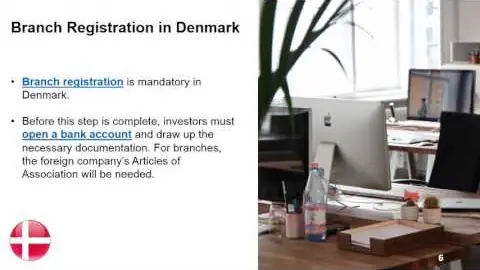
We invite you to watch a short video on how to establish a branch in Denmark:
What are the main regulations to follow after opening a branch in Denmark?
- After receiving a unique registration number, the Danish branch must also register for social security purposes;
- A certified copy of the audited financial statements of the parent company must be filed with the Danish Business Authority (Erhvervsstyrelsen). Also, the bookkeeping is necessary as the branch must pay VAT like any ordinary local company;
- The Danish branch is subject to taxation in the country in 2026 at the applicable rate of 22%. It is treated as a permanent establishment in Denmark for taxation purposes.
What is the time required for establishing a branch in Denmark?
The time required for establishing a branch in Denmark varies depending on the following factors:
- For straightforward applications: 1-2 weeks after submitting all the required documents.
- For complicated cases (especially in the case of non-EU enterprises): 3-6 weeks.
It may get delayed due to the following reasons:
- Missing documents or documents that have not been legalized/approved;
- Translation of the documents in Danish/English language;
- Unregulated economic activity.
Why is a branch a good choice in Denmark?
There are many advantages to choosing to open a branch in Denmark:
- Simpler to start: does not require setting up another entity;
- More cost-effective: less expensive than creating a subsidiary;
- Full control for the parent company over its operations;
- Access to the Danish and EU market through a branch;
- Only taxed on earnings from Denmark.
Please feel free to contact our specialists in company formation for more details regarding Danish branches. We can also help you with opening a company in Canada through our local experienced partners from BridgeWest Canada.